Yes, Trustpilot is legit, but the answer is not as simple as “trust every rating you see.”
Trustpilot is a real consumer review platform and a publicly traded company on the London Stock Exchange under the ticker TRST. It hosts more than 330 million reviews, reaches about 60 million monthly active users, and reported removing 4.5 million fake reviews in 2024, with most detected automatically by AI.
But “legit” does not mean “perfect.” Trustpilot still has problems with fake reviews, unverified reviews, paid business tools, review disputes, and user frustration when genuine reviews are flagged or removed.
This guide explains what Trustpilot does well, where it falls short, and how to read a Trustpilot profile before you trust it.
Is Trustpilot Legit? The 5-Point Answer
Yes, Trustpilot is a legitimate company and review platform. But its ratings should be used as one trust signal, not the only proof that a business is reliable.
Here is the short answer:
- Trustpilot is a real public company. It was founded in Denmark in 2007, listed on the London Stock Exchange in March 2021, and continues to operate as a major global review platform.
- The review platform itself is legitimate. Consumers can leave reviews for free. Businesses cannot pay Trustpilot to remove negative reviews or buy a higher TrustScore.
- Fake reviews still slip through. Trustpilot reported removing 4.5 million fake reviews in 2024, with 90% detected automatically by AI. That shows active enforcement, but it also shows the size of the fake-review problem.
- The paid business model creates bias concerns. Paying businesses get more review management tools, automation, and support access than free accounts. Trustpilot says the same review rules apply to everyone, but the tools are not equal.
- Trustpilot is useful when you read patterns, not just stars. A 4.8-star rating means more when reviews are verified, consistent over time, specific, and supported by similar feedback on Google Reviews, BBB, Reddit, or niche review platforms.
If you want the practical answer: Trustpilot is legit, but you should not trust a Trustpilot rating blindly.
What Is Trustpilot?
Trustpilot Group plc is a consumer review company that runs one of the largest open review platforms in the world.
The platform allows people to review businesses, products, and services. Businesses can claim their profile, respond to reviews, invite customers to leave feedback, flag reviews that may break rules, and use paid tools to manage their reputation.
Trustpilot’s legitimacy comes from several factors:
- It is publicly traded on the London Stock Exchange.
- It has operated since 2007.
- It publishes trust and transparency data.
- It uses automated fraud detection and human review moderation.
- It has hundreds of millions of published reviews.
- It is widely used by global ecommerce, SaaS, finance, travel, and service businesses.
That makes Trustpilot very different from a small anonymous review site with no public accountability.
Still, a legitimate platform can contain unreliable reviews. That is the key distinction. Trustpilot can be a real company while some reviews on the platform may still be fake, biased, outdated, incomplete, or disputed.
How Trustpilot Reviews Actually Work
Trustpilot uses an open-review model. That means consumers can leave reviews about businesses, even if the business does not pay for Trustpilot or actively manage its profile.
This openness is part of what makes Trustpilot useful. It gives customers a public place to share feedback, and it gives businesses a way to show social proof.
But the same openness also creates risk. If anyone can leave a review, Trustpilot has to deal with fake reviews, competitor attacks, exaggerated complaints, paid positive reviews, and review campaigns designed to influence the overall score.
The basic review system works like this:
- A customer writes a review.
- The review may be verified or unverified.
- Trustpilot’s automated systems scan for suspicious patterns.
- Businesses can respond to reviews.
- Businesses or users can flag reviews that may break the rules.
- Trustpilot may investigate flagged reviews.
- Reviews that break the rules can be taken offline.
This system works well in many cases. But it is not flawless, especially when reviews are unverified or when a business receives a sudden wave of positive or negative feedback.
Verified vs. Unverified Trustpilot Reviews
The difference between verified and unverified reviews is one of the most important things to understand.
Verified reviews are connected to a confirmed customer experience. This can happen when Trustpilot sends an automatic review invitation after a transaction, when a business uploads customer data for review invitations, or when a reviewer provides proof during a dispute.
Unverified reviews are written directly by users without a confirmed transaction attached. Many unverified reviews are honest, but they carry more uncertainty because the purchase or customer experience has not been confirmed.
Both verified and unverified reviews can affect the overall TrustScore.
That is why you should not only look at the star rating. A business with a 4.5-star rating and mostly verified reviews is usually more credible than a business with a 4.9-star rating built mostly on unverified, vague, or one-time reviewer accounts.
When reading any Trustpilot profile, check for the Verified label. Then read several reviews across different rating levels before you make a decision.
How Trustpilot Detects Fake Reviews
Trustpilot uses automated technology and human moderation to detect fake reviews.
The automated system looks for signals such as unusual review velocity, repeated language patterns, suspicious account behavior, device signals, IP patterns, and other fraud indicators. Reviews can also be flagged by businesses, consumers, or Trustpilot’s own systems.
Trustpilot reported removing 4.5 million fake reviews in 2024, and said 90% of those were detected automatically by AI.
That is a strong signal that Trustpilot actively fights fake reviews. But it also proves that fake reviews are a serious problem at scale.
No review platform catches everything. Some fake reviews may stay live long enough to influence a score. Some real reviews may also get flagged by mistake. That is why review moderation creates frustration on both sides.
Consumers often complain when genuine negative reviews are challenged or removed. Businesses complain when fake negative reviews stay live for too long. Both complaints can be valid because review moderation is difficult, especially on a large open platform.
Where Trustpilot Falls Short
This is where the answer becomes more nuanced.
Trustpilot is legitimate, but it has real weaknesses. These weaknesses do not mean the whole platform is fake. They mean readers should use Trustpilot carefully.
1. Fake Reviews Can Still Slip Through
Trustpilot removes millions of fake reviews, but some fake reviews still appear.
Common red flags include:
- Many reviews posted within a short time.
- Generic praise with no details.
- One-review accounts.
- Sudden 5-star review spikes after bad publicity.
- Sudden 1-star review spikes after a dispute or product launch.
- Repeated wording across multiple reviews.
- Reviews that do not describe a real customer experience.
A few suspicious reviews do not prove a business is dishonest. But a pattern of vague, repetitive, or unnatural reviews should make you cautious.
2. Unverified Reviews Still Affect Scores
Unverified reviews can be useful, but they are less reliable than verified reviews.
This matters because unverified reviews still count toward the public rating. A business may look stronger or weaker depending on how many unverified reviews it receives and whether those reviews are genuine.
For consumers, this means the TrustScore is only the starting point. The real value comes from reading the review mix, checking the verified ratio, and looking for repeated themes.
3. Review Removal Creates Frustration
Trustpilot allows businesses to flag reviews that may break platform rules. That is necessary because fake, abusive, or irrelevant reviews can harm a business unfairly.
But this also creates user frustration. Some consumers feel that negative reviews are challenged too often. Some businesses feel that fake reviews are not removed quickly enough.
Trustpilot says businesses cannot pay to remove negative reviews. The official process is based on platform rules. Still, the review dispute process can feel unclear or slow, especially when the outcome is not explained in detail.
4. Paid Tools Create Bias Concerns
Trustpilot offers paid business tools. These tools can help companies invite customers, manage review requests, respond faster, access analytics, and handle reputation workflows more efficiently.
The concern is not that businesses can directly buy better ratings. The concern is that paid businesses may have better systems, support, and automation for managing reviews than free businesses.
Trustpilot’s position is that all reviews follow the same rules, regardless of whether a business pays. That distinction matters.
Still, the tools are not equal. A paid business with review automation and a stronger flagging workflow may manage its profile more effectively than a free business that handles disputes manually.
That does not make Trustpilot a scam. But it does mean readers should understand how platform incentives can affect review visibility and profile management.
Can You Trust Reviews on Trustpilot?
Mostly, yes, if you read them correctly.
Trustpilot reviews are most useful when you look for patterns instead of relying on a single rating. The star score gives you a quick signal, but the details inside the reviews tell you much more.
Use this checklist before trusting a Trustpilot profile:
- Check how many reviews are verified.
- Read the 1-star, 2-star, and 3-star reviews first.
- Look for repeated complaints from different users.
- Check whether positive reviews include specific details.
- Watch for review spikes or sudden rating changes.
- Read how the business responds to complaints.
- Compare Trustpilot with Google Reviews, BBB, Reddit, and industry-specific platforms.
A few bad reviews do not mean a company is bad. Every real business gets complaints. What matters is whether the same problem appears again and again.
For example, repeated complaints about refunds, delivery delays, billing issues, or poor support are more important than one emotional review from a single unhappy customer.
Can Businesses Pay to Remove Negative Trustpilot Reviews?
No, businesses cannot directly pay Trustpilot to remove negative reviews or buy a better TrustScore.
Businesses can flag reviews they believe break Trustpilot’s rules. Trustpilot then decides whether the review should stay online, be investigated, or be taken offline.
That said, paying businesses may have more tools to manage review invitations, monitor feedback, and handle review workflows. This can create the perception that paying businesses have more control.
The practical takeaway is simple: do not assume every removed negative review was unfairly deleted, and do not assume every remaining negative review is accurate. Review disputes can involve fake reviews, missing proof, policy violations, privacy issues, or genuine customer complaints.
How Consumers Should Use Trustpilot
Consumers should treat Trustpilot as a research tool, not a final verdict.
Start with the TrustScore, but do not stop there. Open the review profile and look for the story behind the rating.
A trustworthy Trustpilot profile usually has:
- A steady review history.
- A mix of positive and negative reviews.
- Specific customer details.
- Many verified reviews.
- Professional business responses.
- Similar feedback across other review platforms.
A suspicious profile may have:
- A perfect score with almost no negative reviews.
- Many vague 5-star reviews.
- A sudden burst of reviews in a short period.
- Mostly unverified reviews.
- Repeated review wording.
- Many one-review accounts.
- No thoughtful replies to complaints.
If a purchase is expensive, risky, or hard to refund, cross-check more carefully. Trustpilot is helpful, but it should not be your only source.
How Businesses Use Trustpilot Reviews
Businesses use Trustpilot to collect customer feedback, build public trust, respond to complaints, and show potential buyers that real customers have used their service.
For ecommerce brands, Trustpilot can help reduce buyer hesitation when shoppers are researching a store for the first time. This is especially important for newer brands, high-ticket products, subscription products, international sellers, and categories where customers worry about refunds, delivery, or product quality.
But Trustpilot works best when it is part of a broader trust strategy.
A business should not rely only on a Trustpilot badge or a high star rating. It should also make reviews visible where shoppers make decisions, such as product pages, landing pages, checkout pages, and post-purchase flows.
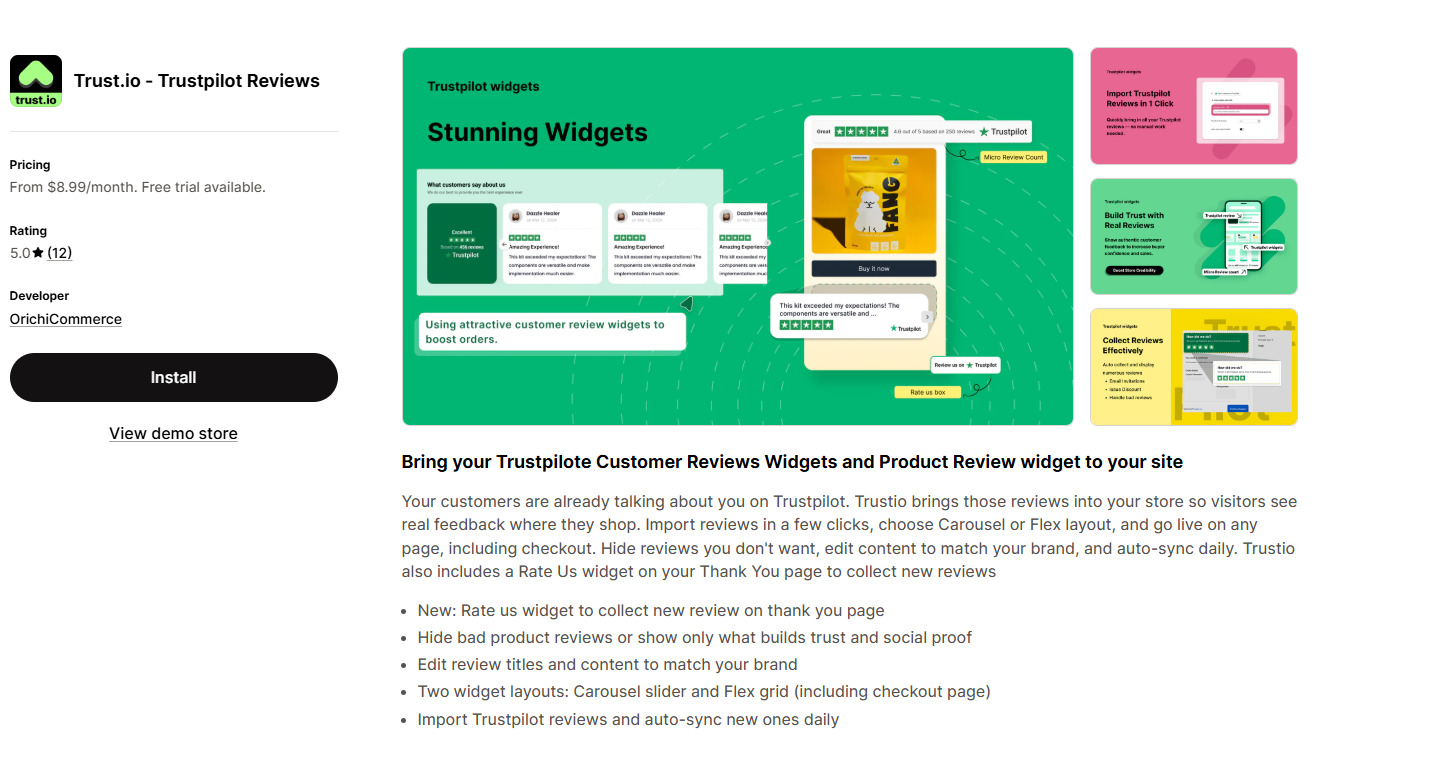
For Shopify merchants that already have Trustpilot reviews, a practical next step is to display that feedback directly on the store. Trust.io – Trustpilot Reviews helps Shopify merchants import Trustpilot reviews, display them in review widgets, choose Carousel or Flex layouts, auto-sync new reviews daily, and add a Rate Us widget on the Thank You page.
Import Trustpilot Reviews to Shopify with Trust.io – Trustpilot Reviews
Is Trustpilot Worth Paying for as a Business?
Trustpilot may be worth paying for if your customers actively research your brand before buying.
It is most useful for businesses in categories where trust matters before checkout, such as ecommerce, SaaS, finance, travel, health-related products, and higher-risk purchases.
Trustpilot paid tools may be useful if:
- You sell globally.
- Customers search your brand before buying.
- You have enough order volume to request reviews consistently.
- You want a stronger review collection workflow.
- You use reviews as part of your conversion strategy.
- You need reputation management tools across a larger team.
Trustpilot may not be the best fit if:
- You are a small local business that depends mainly on Google Maps.
- You need detailed product-level reviews more than company-level reviews.
- You sell mostly on Amazon or another marketplace.
- You cannot justify the subscription cost.
- You want full control over review display on your own website.
For many Shopify merchants, the strongest approach is to combine an external trust signal with on-site review visibility. Trustpilot can support brand trust, while on-site widgets can help shoppers see relevant customer feedback while they browse and buy.
Red Flags to Watch for on Any Trustpilot Profile
Before you trust a Trustpilot profile, look for these warning signs:
Trustpilot Warning Banners
If Trustpilot displays a public warning about misuse of the platform, take it seriously. This is one of the clearest red flags available.
Sudden Review Sprints
A large number of reviews posted in a few days can be suspicious, especially if the account was quiet before and after the spike.
This does not always prove manipulation. A business may have run a legitimate review request campaign. But you should read those reviews carefully.
Perfect Scores With No Criticism
Real businesses usually have at least some negative reviews. A perfect or near-perfect score with no meaningful criticism can look unnatural, especially if the reviews are vague.
Generic Review Language
Reviews like “Great service,” “Highly recommend,” or “Amazing company” are not very useful unless they include details.
Specific reviews are stronger. Look for mentions of delivery, support, refund handling, product quality, onboarding, pricing, or the exact customer problem solved.
Mostly One-Review Accounts
If many reviewers have only left one review, be cautious. This can happen naturally, but a large pattern of single-review accounts may suggest review campaigns or fake activity.
Repeated Complaints
Repeated negative themes matter more than isolated complaints.
If many reviewers mention the same issue, such as delayed refunds, hidden fees, poor support, or failed delivery, treat that pattern as meaningful.
Poor Business Responses
A legitimate business should respond to negative reviews with professionalism. If a company ignores serious complaints, blames every customer, or gives copy-paste replies, that is a trust problem.
Trustpilot vs. Other Review Platforms
Trustpilot is not the only review platform, and it is not always the best one for every situation.
Here is the simple comparison:
| Platform | Best For | Key Strength | Key Weakness |
|---|---|---|---|
| Trustpilot | Global brand trust and company reviews | Large public review platform | Unverified reviews and paid-tool concerns |
| Google Reviews | Local businesses and Maps visibility | Strong local discovery | Limited business control and weaker moderation |
| BBB | US complaint history and dispute resolution | Useful for complaint research | Not a modern ecommerce review tool |
| G2 | B2B software reviews | Strong SaaS buyer intent | Not designed for general consumer businesses |
| Sitejabber | Ecommerce and service reviews | Consumer-focused reviews | Smaller audience than Trustpilot |
| On-site review tools | Product pages and conversion support | More control over display | Not always seen as independent |
Most serious brands should not depend on one platform. A stronger trust strategy usually combines external reviews, on-site reviews, customer testimonials, and transparent responses to complaints.
For Shopify stores, this means Trustpilot can help with public brand trust, while an on-site widget can help shoppers see review content at the moment they are deciding whether to buy.
Should Shopify Merchants Display Trustpilot Reviews on Their Store?
Yes, if the reviews are real, relevant, and useful for shoppers.
Many buyers leave a store to search for reviews before they purchase. If your store already has strong Trustpilot feedback, showing those reviews on your Shopify site can reduce friction and keep shoppers closer to checkout.
This does not make the reviews more authentic. It simply makes existing customer feedback easier to find.
A Trustpilot review importer for Shopify can help merchants:
- Import Trustpilot reviews into Shopify.
- Display Trustpilot customer reviews on store pages.
- Add widgets to product pages, landing pages, checkout, or other pages.
- Use Carousel slider or Flex grid layouts.
- Auto-sync new Trustpilot reviews daily.
- Collect new feedback with a Rate Us widget on the Thank You page.
- Manage which reviews appear in on-site widgets.
- Edit review titles and content for clearer brand presentation.
If you already use Trustpilot and want shoppers to see that feedback while they browse, Trust.io – Trustpilot Reviews is a practical option for importing and displaying Trustpilot reviews on Shopify.
Add Trustpilot Reviews to Shopify with Trust.io
The Bottom Line
Trustpilot is legit as a company and useful as a review platform. It is publicly traded, widely used, and has real systems for detecting fake reviews.
But Trustpilot is not perfect. Fake reviews can slip through. Unverified reviews still affect ratings. Review disputes can frustrate both consumers and businesses. Paid business tools also create fair concerns about unequal review management power.
As a consumer, trust Trustpilot when the review pattern is consistent, specific, verified, and supported by other sources. Be cautious when reviews are vague, unverified, unusually timed, or very different from what you see on Google Reviews, BBB, Reddit, or niche platforms.
As a business, use Trustpilot when your customers care about independent social proof. But do not depend on Trustpilot alone. Build trust across the platforms your customers actually check.
For Shopify merchants, the practical next step is simple: if you already have Trustpilot reviews, bring them onto your store so shoppers can see real customer feedback while they browse and buy.
Install Trust.io – Trustpilot Reviews
Frequently Asked Questions
Can You Trust Reviews on Trustpilot?
Mostly, yes, but not blindly.
Verified reviews are stronger because they are connected to a confirmed customer experience. Unverified reviews can still be genuine, but they carry more risk.
Before you trust a rating, check the verified ratio, read lower-star reviews, look for repeated themes, and compare the business with other review sources.
Are Trustpilot Reviews Fake?
Some Trustpilot reviews are fake, but not all of them.
Trustpilot reported removing 4.5 million fake reviews in 2024, with most detected automatically by AI. That shows the platform actively fights fake reviews, but it also shows that fake reviews are a real problem.
The best approach is to look for patterns, not isolated reviews.
Can Businesses Pay to Remove Negative Trustpilot Reviews?
No. Businesses cannot directly pay Trustpilot to remove negative reviews or buy a better TrustScore.
They can flag reviews that may violate Trustpilot’s rules. Trustpilot then decides whether the review should stay online or be taken offline.
What Is the Difference Between Verified and Unverified Trustpilot Reviews?
Verified reviews are connected to a confirmed customer experience. This may happen through a Trustpilot invitation, a business-uploaded customer record, or proof provided during a dispute.
Unverified reviews are written without confirmed transaction proof. They may still be honest, but they require more caution.
How Does Trustpilot Detect and Remove Fake Reviews?
Trustpilot uses automated fraud detection and human moderation.
Its systems look for suspicious behavior, review patterns, account signals, and other fraud indicators. Human teams also review flagged content and disputes.
Is Trustpilot Worth Paying for as a Business?
It depends on your business model.
Trustpilot is more useful for brands that sell online, operate globally, or work in categories where buyers research reputation before purchasing. It may be less useful for small local businesses that rely mainly on Google Reviews.
Should Shopify Stores Use Trustpilot Reviews?
Yes, if the store already has helpful Trustpilot feedback and wants to show that feedback on-site.
A Shopify app like Trust.io – Trustpilot Reviews can help merchants import Trustpilot reviews, display review widgets, auto-sync new reviews, and collect more feedback after purchase.
What Should I Do Before Trusting a Trustpilot Rating?
Read the review details, not just the score.
Check verified reviews, read negative feedback, look for repeated complaints, review company responses, and compare the business with other platforms. If the same pattern appears across several sources, you can trust the conclusion more confidently.